Review
Battle in Outer Space
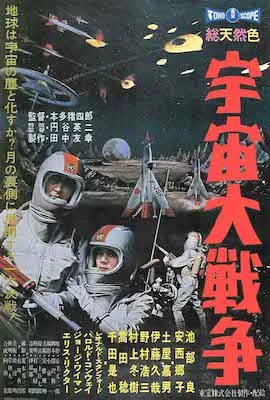
Battle in Outer Space, or Uchû Daisensô (Great Space War) in the original Japanese, was released on December 26th, 1959. It was produced by Toho, runs for 93 minutes, and was filmed in color widescreen via TohoScope. It is Toho’s second alien invasion film after The Mysterians (1957) , and like that film is also based on a story by science fiction author Jojiro Okami. Battle in Outer Space serves as a quasi-sequel to The Mysterians; various characters in both films share the same name, although portrayed by different actors, and the art direction and design of the alien props was apparently based on the assumption that this would be a direct sequel. The Mysterians was Toho’s previously most ambitious project, so naturally Battle in Outer Space would have to surpass it in every way. Producer Tomoyuki Tanaka once again turned to the reliable creative partnership of director Ishiro Honda, effects director Eiji Tsuburaya, composer Akira Ifukube, and screenwriter Shinichi Sekizawa to develop it.
The film actually contains very little in terms of plot, instead depicting a single expansive military action between Earth and the invading Natal. The Natal open hostilities by blowing up an orbiting space station and then wreak havoc on various Earth-based landmarks. They even resort to subterfuge and sabotage to try and derail Earth’s militarized space program. Mankind retaliates with a rocket strike team which takes out the Natal’s advance base on the moon. In the end the combined space might of both Natal and Humanity meet in pitched battle, in orbit high above the Earth, and even in the skies above Tokyo.
The cast is led by Ryo Ikebe, a handsome leading man who was more at home in war films and romances. Here he plays Katsumiya, a military officer heading up the development of Earth’s space arsenal. He certainly cuts a dashing, heroic figure, and he’s the only cast member who gets to leave his helmet off during the rocket scenes, so we can all get a nice view of his immaculate hairdo. The romantic lead is played by Kyoko Anzai. Anzai’s career was short but active; she retired in 1961 after marrying actor Tatsuya Mihashi. Koreya Senda plays Dr. Adachi, apparently inheriting the role from Takashi Shimura. Senda’s never played a very charismatic scientist — see Varan the Unbelievable or The H-Man — and he wasn’t about to start now. Minoru Takada plays the supreme commander of Earth’s defense forces. He previously appeared in the genre as the gangster villain in Motoyoshi Oda’s Invisible Man (1954), and he would go on to appear as the Prime Minister in Ghidorah, the Three-Headed Monster (1964). The best performance of the film is Yoshio Tsuchiya as an astronaut who is brainwashed by the Natal. Tsuchiya not only nails the part, but being a huge space nerd he also consulted with the effects staff on how to film astronauts walking on the moon and rockets launching into the atmosphere. The usual crowd of Toho supporting actors fills out the cast, along with several Caucasian faces (including regular Harold Conway) to improve the film’s chances of finding an audience overseas.
The special effects are an integral part of Battle in Outer Space’s story, and there’s hardly any runtime where there isn’t some kind of effect in play. Tsuburaya’s miniature work steals the show; the film is packed to the brim with rockets, lunar rovers, alien moon bases and space fighter jets. As with The Mysterians, the “worst” effects are some messy blue-screen shots, particularly of pilots in their space jet cockpits. Stand out scenes include the lunar rovers gliding over the lunar surface and the space jets launching in sequence to meet the alien threat in the atmosphere. The pièce de résistance has to be the Natal mothership, which hovers over Tokyo and literally sucks up buildings, cars, and people like a giant shop vac with lasers. Sharp eyed viewers may note that the Natal ships are redressed miniatures from The Mysterians. And even within this film, the Natal mothership appears to be a repainted version of the Natal moon base prop. The moon setting itself is superb. Wide shots of the actors were filmed on location in the lava fields of Mt. Mihara, and were blended seamlessly with matte paintings, studio sets, and miniatures.
Ifukube graces the film with some of his most frenetic and popular action march music. The main title theme proved popular enough to close out the first movement of Ifukube’s Symphonic Fantasia, and it was even recycled for Godzilla vs. Gigan’s stock soundtrack in 1972. The main battle march is a blend of Ifukube’s previous military marches as well as the depth charge attack theme from the original Godzilla (1954), which is now more commonly known as the “Monster Zero March” for it’s use in Invasion of Astro-Monster (1965). This battle music was also selected to play under the climactic scenes from 2016’s Shin Godzilla. One of the quieter cues, played when the astronauts disembark on the moon, is actually an early version of what would later become King Ghidorah’s theme.
Leaving aside Tsuchiya’s alien possessed astronaut, there’s not much in the way of character development or “plot,” since the film is one long battle. Director Honda does barely manage to work in some of his favorite themes. He depicts the nations of Earth as reluctant to repay violence for violence until they learn more about the Natal, but when it becomes clear that there can be no peace between them, mankind is united in a common purpose. Even Honda is willing to admit that we can’t be pacifists all the time, just so long as we’re fighting an existential threat, and not each other.
Overall this is a solid effort from Toho and a good bookend to the 50s. It’s startling to consider how far Tsuburaya & company progressed in the mere 6 years separating Godzilla and Battle in Outer Space. This time though they may have gone just a little overboard; the final battle runs for a solid 10 minutes of film, or in other words, “too long.” Leaving off some effects scenes to elevate the human characters more might have served the film better. I rate it 3 stars out of 4.