Godzilla
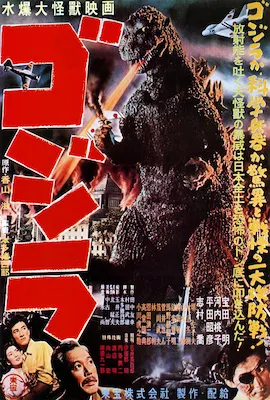
Godzilla, or Gojira in the original Japanese, was released on November 3, 1954, a day now known around the world as “Godzilla Day.” Produced by Toho, it runs 97 minutes, filmed in black and white in 1.37:1 aspect ratio. This is the first film in the Godzilla franchise, the oldest surviving film of the kaiju eiga genre, and the first to feature the classic “man in suit” style of special effects pioneered by Eiji Tsuburaya. It was produced by Tomoyuki Tanaka, whose original war film project was canceled due to postwar tensions between Japan and his Indonesian partners. Tanaka and Tsuburaya were both influenced by American monster films like King Kong (1933) and The Beast from 20,000 Fathoms (1954) and pitched their own monster movie to Toho as a replacement. Tsuburaya was fresh off of the U.S. occupation blacklist for his work on wartime propaganda films and eager to tackle a new challenge. While he admired King Kong, the budget would not allow for similar stop-motion techniques, and "suitmation" was developed in its stead. Godzilla was also the first kaiju film directed by Ishiro Honda, who would work frequently in the genre throughout the 50s and 60s. Honda, a war vet and lifelong friend of Akira Kurosawa, was selected because he took the subject matter seriously when other directors wouldn't. Honda and screenwriter Takeo Murata reworked a short story by novelist Shigeru Kayama into the final script, which included none-too-subtle political themes inspired by the infamous Lucky Dragon No. 5 nuclear incident. The name "Gojira" derives from a contraction of the words "gorilla" and "kujira" (or "whale"), and was intended to convey the title creature's size and strength.
The film opens with mysterious boating disasters near a backwater fishing village on Odo Island. News reporter Hagiwara interviews the inhabitants and learns the legend of "Godzilla", an ancient creature worshipped by the islanders. A storm hits and an unseen force rises from the sea to destroy the village. Yamane, a prominent scientist, leads an expedition to the island, where he discovers huge radioactive footprints filled with prehistoric detritus. The monster Godzilla appears, and Yamane warns Japan to prepare for the worst. Before long Godzilla visits the mainland, and the Self-Defense Force mounts a futile defense of the capital.
Meanwhile the three younger leads — sailor Ogata, Emiko Yamane (the scientist’s daughter), and reclusive scientist Serizawa, who is betrothed to Emiko — are entangled in a romantic subplot. Emiko’s heart belongs to Ogata, and they want Serizawa to break the engagement. But when Emiko visits him with this purpose, Serizawa reveals the terrifying fruits of his research and swears her to secrecy. Only after Godzilla’s brutal assault on Tokyo do the secrets come out: Ogata and Emiko’s romance, and Serizawa’s invention, which just might be the only thing capable of destroying the monster.
The acting is decent all around. Akira Takarada’s and Momoko Kouchi’s performances are a little stilted (naturally, they're both fresh faced actors here), but Akihiko Hirata shines as the tormented Serizawa (his most iconic role). Takarada and Hirata appeared in several more Godzilla films (Hirata last in 1975’s Terror of Mechagodzilla, Takarada in 2004’s Godzilla: Final Wars). Kouchi appeared in two more Honda science-fiction films before retiring, later reprising Emiko in 1995’s Godzilla vs. Destoroyah (her final film). Takashi Shimura is reliably cast as the fatherly scientist, inheriting the gravitas of his chief samurai in Seven Samurai earlier that year. Lively support comes from Sachio Sakai as reporter Hagiwara and Kuninori Kodo as the crusty village chief (also basically reprising his role from Seven Samurai). Kenji Sahara and Yu Fujiki, who would both go on to have substantial roles in later genre films, make fleeting appearances here. And don't miss the intrepid suit actors Katsumi Tezuka and Haruo Nakajima in their "out of costume" roles in Hagiwara's newsroom.
This being the first film of its kind, the effects are a mixed bag of experimental techniques. Most of Godzilla’s scenes use Nakajima in a stiff, hundred-pound rubber suit with no ventilation or visibility. The intense lighting required for high-speed filming raised the temperature inside to 140°F, and after each session the suit had to be drained of his sweat. A hand puppet, which unfortunately does not resemble the suit, is used for closeup scenes such as Godzilla's first on-screen appearance peeking over a hill and the unintentionally funny Tokyo Tower sequence.
Yet the miniature effects during Tokyo’s destruction and its aftermath are superbly done. Godzilla melting the electrical towers (wax models under heat lamps) is particularly effective, and the matte shots on Odo Island (actors in the foreground, destroyed buildings and a Godzilla footprint in the background) are nearly flawless. Fleeting stop-motion can still be seen here and there (Godzilla's tail flailing, a fire truck crashing) along with visible guide wires on fighter jets. (This is all par for the course in the genre and generations of fans really don't seem to mind.) Without Tsuburaya’s ingenuity and Nakajima’s tenacity, the whole enterprise simply would not have been possible.
The music for the movie was composed by Akira Ifukube, who also created the sound effects for Godzilla's iconic roar and footsteps. Ifukube's score is filled with repetitive ostinato themes, several of which became standard Godzilla tunes. The main title military march evolved over time into the character’s signature theme, heard as recently as Godzilla Minus One (2023). The dirge during Tokyo’s destruction and a brief expedition march (later the “Monster Zero March”) also saw later reuse across the series. The highlight is the “Prayer for Peace,” a girls’ choir hymn sung in the aftermath of Tokyo's destruction. The shrill violin cue that underscores Serizawa unveiling his secret weapon is also noteworthy.
Honda’s direction lends the film's nuclear theme a uniquely Japanese perspective. Where American films treated radioactivity as a casual gimmick, Godzilla, produced by the only nation attacked by nuclear weapons, deliberately evokes Hiroshima and Nagasaki in the somber aftermath of Tokyo’s rampage, setting up a stark allegory. Otherwise, the story beats closely mirror those of contemporaneous American science-fiction films.
If I’m being honest, I’m torn. The film is decent enough, reminiscent of American films in plot and characterization, and the effects vary from incredible to distracting. On the other hand, the potent combination of Tanaka, Honda, Tsuburaya, Nakajima, and Ifukube ignited the kaiju eiga genre and defined it for decades to come. Later films improved on the formula, but they all owe their existence to the original Godzilla. Its indelible influence is still felt today, even if it is not a perfect film. I rate this 3 stars out of 4.