Godzilla Raids Again
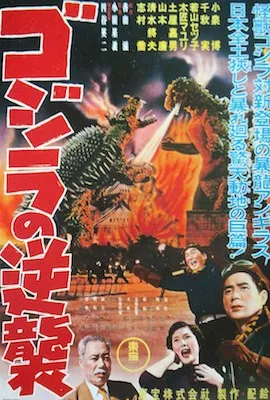
Godzilla Raids Again, or Gojira No Gyakushû (Godzilla's Counterattack) in the original Japanese, was released on April 24, 1955. Produced by Toho, it runs 81 minutes, filmed in black and white in 1.37:1 aspect ratio. It is the second film in the Godzilla series, released only six months after the 1954 original and four months after director Motoyoshi Oda’s previous film Invisible Man. It is the first Godzilla film to pit Godzilla against another monster and the first in the series with a soundtrack by Masaru Sato. Like its predecessor, it draws inspiration from a short story by Shigeru Kayama, with screenwriter Takeo Murata returning alongside Shigeaki Hidaka. Eiji Tsuburaya returns as special effects director and continues to innovate on the suitmation techniques pioneered in the previous film. After the success of the original, producer Tomoyuki Tanaka was eager for a sequel. Ishiro Honda was already at work on Half Human (1955), which encountered delays, so Tanaka kicked off production to fill the release schedule. Oda, known for extraordinarily tight schedules, was a natural choice. Rather than lean into the darker tone of Honda’s film, Oda delivered a lighter sequel focused on character more than allegory. The nuclear metaphor is reduced to a one-time plot device justifying the monsters and is never spoken of again.
The film focuses on the employees of Marine Fisheries, especially its two pilots, Tsukioka and Kobayashi, and the radio girls in the home office, including Hidemi, the boss’s daughter and Tsukioka’s love interest. Kobayashi’s plane malfunctions and is forced to land on a remote island, where both pilots encounter two monsters. Scientists confirm that one is the same species as the Godzilla who raided Japan the year before; the other, Anguirus, is a different but equally formidable species. The monsters are impervious to conventional weaponry, so the defense force decides to stall the monsters and draw them away from the mainland. Through a series of unfortunate events the monsters are accidentally drawn into the heart of Osaka. The fishery employees watch helplessly as their headquarters is laid waste while Godzilla defeats Anguirus in a fight to the death. Life goes on; they transfer most of their staff to another fishery in Hokkaido and hold a rowdy gathering at a rustic inn to boost morale. The revelry is cut short when Godzilla reappears off the coast. The pilots leap into action and the stage is set for the final showdown
Hiroshi Koizumi leads as Tsukioka in a rare glimpse of him as a dashing leading man (and a pilot no less); he reportedly had fond memories of the role for precisely this reason. Koizumi would go on to become a genre regular, mainly playing scientists. Tsukioka is paired with the comedic Kobayashi, played by Minoru Chiaki in his only kaiju eiga appearance. Chiaki is better known for dramatic roles in Kurosawa films like Rashomon (1950) and Seven Samurai (1954), but he slips into the part effortlessly. Setsuko Wakayama plays Hidemi — an office gossip, spoiled boss’s daughter, and playful girlfriend — with a surprising amount of depth, given she doesn't have much to do for the plot while the men are out fighting monsters. Frankly, Wakayama and Koizumi make a better romantic couple than Takarada and Kouchi did in the previous film. Yoshio Tsuchiya and Ren Yamamoto (returning from the first film) play Tsukioka’s wartime buddies, while Seijiro Onda (also returning) shines as their former captain. Takashi Shimura briefly reprises Dr. Yamane, the first recurring human character in the series, to cement the chronology between this film and Godzilla (1954). Character duds include Yukio Kasama as Hidemi’s father and a redundant stereotypical scientist played by Masao Shimizu.
The special effects are certainly much improved and better executed than in the first film. Monster scenes are brighter, cleaner, and much easier to see. Suit actors Haruo Nakajima and Katsumi Tezuka return, Nakajima taking sole possession of the Godzilla suit while Tezuka donned Anguirus, Godzilla’s first kaiju opponent. This would be Anguirus' only appearance for 13 years until his return in Destroy All Monsters (1968). The choreography for the world’s first kaiju fight is adequate, a solid first effort. One of the most recognizable aspects is the unnatural speed of the monsters, allegedly caused by an error setting the frame rate on one camera; Tsuburaya apparently enjoyed the effect and used the same technique in several more scenes. Puppet fights look even more ridiculous than before (Godzilla has a serious overbite) and evoke a Muppet-style throw-down. Godzilla's climactic showdown with fighter jets features improved model planes and missiles that actually strike their targets, though the sheer volume of explosions goes on far too long. Miniature work is generally great, the highlight being the Osaka Castle miniature, famously rebuilt and reshot after falling “incorrectly." The most shocking effect is the flooding subway tunnel, where several fleeing prisoners meet an untimely end.
Masaru Sato’s score is yet another departure. Whereas Ifukube scored monster scenes with loud, blaring horns and smashing drumbeats, Sato’s only real theme of note is the opening title music. The rest is a bed of low strings and winds that enhances early tracking scenes but often feels absent during the fights, leaving them less dynamic than they should be. In contrast, Sato's later scores in the 60s and 70s would lend their films a boost of energy with jazzy big band sound.
As mentioned previously, Oda’s direction shifts the tone dramatically to favor the lighter character and slice-of-life moments in between the monster fights. The nuclear allegory of the original film is stripped away: all that remains is a recap by way of a silent newsreel flashback of the previous film’s events, stripped of its emotional impact. In the previous film, the tormented Serizawa was burdened with the horrible implications of unleashing his secret weapon on Godzilla. Here, the worst complaint of the main characters is that a monster might prevent them from eating fish. Pacing problems compound the shift. The big Godzilla v. Anguirus fight kicks off less than halfway through (after a lengthy car chase) and ends with Anguirus’s death. The finale with the fighter jets is much less gripping by comparison.
This sequel is certainly a departure in tone, with marked improvements in characterizations, great strides in effects execution (though still not perfect), and a decent storyline that suffers from a few glaring pacing issues. It’s a different animal than the original, but a close call as to whether it’s actually better. While the first film is the classic and more influential of the two, I’m inclined to think the sequel is the more enjoyable one to watch. I rate it a solid 3 out of 4 stars.