Review
The H-Man
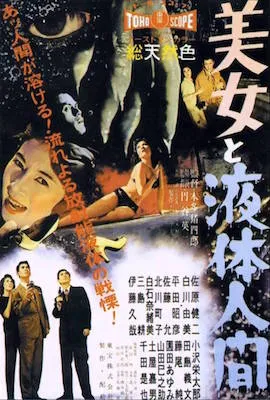
The H-Man, or Bijo To Ekitainingen (Beauty and the Liquid Man) in the original Japanese, was released on June 24th, 1958. It was produced by Toho, runs for 87 minutes and was filmed in color widescreen in TohoScope. This was the second entry in Toho’s informal “transforming human” series, after Invisible Man (1954), and followed by The Secret of the Telegian and The Human Vapor (both 1960). Producer Tomoyuki Tanaka once again reunited director Ishiro Honda and effects director Eiji Tsuburaya to work on this film, this time paired with composer Masaru Sato, his second collaboration with Honda after Half Human (1955), and screenwriter Shinichi Sekizawa. Sekizawa and Honda would collaborate on various sci-fi projects throughout the 1960s. While you might think this film was inspired by the The Blob starring Steve McQueen, that film was actually released in October of 1958, four months after The H-Man. In fact, Honda’s independent research at the JRR-1 plant in Tokai, where he learned about the effects of intense radiation on living tissue, inspired the H-Man concept, which was embellished for the screen by borrowing elements from Japanese vampire folklore.
The film follows inspector Tominaga, who is trying to unravel a drug smuggling operation led by seedy nightclub boss Uchida. Things take an unexpected turn when several persons of interest seemingly disappear into nothing, leaving their clothes behind. Tominaga’s college buddy Masada, a scientist, believes the disappearances are the work of cannibal liquid mutants, known as “H-Men,” who arrived to Japan aboard an irradiated fishing vessel. The H-Men become more bold in their attacks, forcing Tominaga to suspend his investigation and focus on eradicating the new menace. All threads culminate in a showdown in the city sewers between cop, scientist, gangster, and monster.
Kenji Sahara leads his third science fiction film of the decade as the earnest but oblivious Masada, and for the third time Yumi Shirakawa plays his love interest, nightclub singer Chikako. The pair previously appeared in both Rodan (1956) and The Mysterians (1957). Akihiko Hirata returns to the genre as well, this time as a police detective instead of a scientist. Masada and Tominaga are old college friends, which was no challenge for Sahara and Hirata, as they were close friends offset as well. Although Masada does push the boundaries of their friendship by constantly getting underfoot in Tominaga’s investigation, pestering him about his H-Man theory and even going so far as to lug a radioactive life preserver into the station to make his point. Tominaga’s crew of detectives feature well known faces like Yoshibumi Tajima, Yoshio Tsuchiya, and veteran actor Eitaro Ozawa. Koreya Senda plays Masada’s mentor, the respectable Dr. Maki, his second such role in 1958 along with Varan the Unbelievable. The best performance of the film belongs to Makoto Sato as the gangster Uchida. The H-Man was one of Sato’s early films when he was frequently cast as villains, and he would find later fame starring in war films and gangster films, particularly for director Kihachi Okamoto. Noteworthy cameos include stalwart Toho monster suit actors Haruo Nakajima and Katsumi Tezuka as members of the ill-fated fishing boat, along with perennial scaredy-cats Haruya Kato, Shigeo Kato, and Senkichi Omura. Yosuke Natsuki makes his first ever film appearance as an eyewitness of the first H-Man attack. Natsuki would later have leading roles in genre films like Ghidorah, the Three-Headed Monster and Dogora (both 1964).
The H-Men aren’t actually shown until a flashback scene about halfway through the film, which also happens to be the film’s standout sequence. Honda is not remembered as a horror director, but when he had a chance to do a horror sequence, he nailed it every time. The H-Man effect was accomplished alternately with a thick, gelatinous fluid, captured via some creative camera angles, animated cels, or a hazy comp of an actor wearing an H-Man “suit.” The H-Man effects, along with the effects of the victims melting away into nothing, work best in dark scenes, such as the fishing boat and later the sewers, but falter in brighter shots such as the dressing room in the nightclub. In the former they are eerie and unsettling; in the latter, less so. Honda also took a crack at directing a car chase scene, a bizarre low-speed affair that ends in a spinning blur transition to suggest a crash rather than show it.
Masaru Sato’s score is a mixed bag. Most of the score lurks in the background under the action; the H-Man scenes are scored with nothing more than a faint whining drone to induce anxiety. The actual main title “theme,” which plays over the credits and again towards the climax, is an exuberant, carnival-like tune that is neither suitable for a horror film nor a gangster crime film.
Speaking of genres, like the other entries of the Transforming Human series, The H-Man is structured like a police procedural which takes a left turn into the bizarre and macabre. This would become a trend as Toho experimented with introducing fantastic elements into other genres, culminating in the successful fusion of kaiju and salaryman comedy in King Kong vs. Godzilla (1962). But as the movies became more whimsical and leaned further into pure escapism, there would be less room for any Honda-style moral lessons. If there is a moral to The H-Man, it’s that the cops should sometimes listen to the scientists, even when they’re being annoying. And also that maybe Honda shouldn’t do any more car chases.
Overall I rate The H-Man 3 out of 4 stars. I thought I would rate it lower, as the first half of the film (fishing boat scene notwithstanding) plods along and holds little interest for me. But the climax in the sewers, with its converging threads and emotional payoffs, not to mention a spectacular fire sequence, outperforms the rest of the film and makes it worth the time.