Half Human
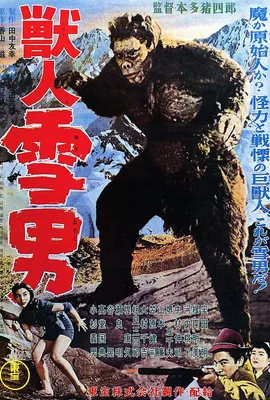
Half Human, or Jûjin Yukiotoko (Beast Man Yeti) in the original Japanese, was released on August 14, 1955. Produced by Toho, it runs 95 minutes, filmed in black and white in 1.37:1 aspect ratio. This was Ishiro Honda’s second monster film after the original Godzilla (1954) and Toho’s fourth postwar special-effects film, following Godzilla, Invisible Man (1954), and Godzilla Raids Again (1955). It was actually in development as far back as the first Godzilla and was meant to release earlier, but delays led to its crew being reassigned to Godzilla Raids Again. Like the earlier Godzilla films, it is drawn from a short story by Shigeru Kayama, with a screenplay by Takeo Murata. Eiji Tsuburaya returns as special-effects director, using costumes, miniatures, stop-motion, and rotoscoping. Unlike Godzilla, it was not influenced by American films of the same genre but by mountaineer Eric Shipton’s 1951 “yeti footprint” discovery, and is only one of several abominable snowman movies of the era such as The Snow Creature (1954) and The Abominable Snowman (1957).
The film is told in flashback and bookended by scenes of the main cast relating the story to a reporter during a layover at a small train station. A group of student friends go on a skiing trip in the mountainous Nagano region. The trip takes a dark turn when the group is separated; half reach the safety of a travel lodge while the others are presumably lost in a blizzard en route to another lodge. When the weather clears they find the second lodge destroyed and their friends either dead or missing. All signs point to a large animal as the culprit.
The search cannot continue in winter, so the story picks up after the thaw when the survivors return with their university professor. They reach the brink of a valley so disreputable that even their experienced guides refuse to lead them further. No sooner do they pitch camp than they are visited by a lumbering ape-like creature: the titular half-human beast. The beast lives in a cave near a secluded village of hunter-gatherers who worship it and its lone offspring as local deities. A crooked exhibitionist and his motley crew arrive on the scene, intent on capturing the beast for profit. The villagers are close-minded, distrustful of outsiders, and prone to violence. As the threads come together, conflict is inevitable and the final outcome is as tragic as one might expect.
The cast is stacked with returning faces from Honda’s prior Godzilla, including leads Akira Takarada and Momoko Kouchi as Takashi and Michiko. Both have come a long way in the mere nine months since Godzilla; their performances are less stilted and more nuanced, and Takarada has already adopted the suave, confident demeanor that would become his trademark. Nobuo Nakamura appears as the university expedition’s mentor/scientist, Professor Tanaka, a capable actor in a very much by-the-book role. Akemi Negishi takes second billing as the exotic tribal girl Chika, while Kuninori Kodo once again plays the village chief, having already played similar roles in Godzilla and Seven Samurai (1954).
The best performance belongs to Yoshio Kosugi as Oba, the over-the-top cruel and greedy exhibitionist who makes everyone else look stale by comparison. Genre regulars such as Sachio Sakai, Yasuhisa Tsutsumi and Akira Sera round out the supporting cast. The villagers themselves are portrayed as primitive, arbitrarily aggressive, and suffering from various physical and mental ailments — caricatures of the burakumin — except for the strangely immune Chika. (The film's treatment of burakumin stereotypes and opposition from advocacy groups has so far prevented Half Human from receiving a home video release since its debut.)
The special effects are once again handled by Eiji Tsuburaya and make use of a man in a monster suit, albeit on a much smaller scale than the average kaiju film. In an interesting twist the creature is not played by Haruo Nakajima but by the multi-talented actor, director, and creature-effects designer Fuminori Ohashi, credited here as Sanshiro Sagara. (Nakajima does however have a cameo as a member of the expedition descending towards the valley.) Ohashi created an early version of the beast costume that was later replaced by a design from sculptor Teizo Toshimitsu. His tall stature combined with the menacing costume produces an impressive, intimidating, and threatening effect; the creature’s less expressive and less convincing offspring does not fare quite so well.
As is typical of Tsuburaya’s work from this era, the effects are a mixed bag. Some scenes are expertly executed with miniatures — Oba’s caravan of trucks careening down a cliffside, the early avalanche — while others, such as Takashi dangling over a ravine, are a little less convincing but still compelling in their own charming way. One of the weirdest effects has Ohashi’s beast man lifting and hurling Kosugi’s Oba. The two actors are not even in the same shot; Ohashi pantomimes the motions while Kosugi is composited into the frame and tracked up and down. It is a jarring effect that only gets sillier the longer one thinks about it.
The music is by Masaru Sato in one of his very few collaborations with Honda (the only other being 1958’s The H-Man). As with his score for Godzilla Raids Again, the music works quietly in the background, never overpowering the action. The opening titles are certainly dramatic, although there are no noticeable recurring themes. One scene in which the beast inexplicably rescues Takashi is accompanied by suitably mysterious and eerie music that is still disappointingly subdued.
Honda’s direction yields a more straightforward creature feature with familiar, formulaic story beats. It gives the distinct impression that it was produced merely to take advantage of the concurrent “yeti craze” rather than to tell any particularly compelling story or teach any profound moral lesson. The depiction of the backwards villagers doesn't help things either; political correctness aside, they are just so unsympathetic that when the beast lashes out at them during the climax you don't really feel anything for them, good or bad. (It's a mystery why Chika spends any more time around them than she absolutely has to, it's obvious they don't like her.)
In the final analysis I have to consider this film a disappointment. The acting is terrific all around, the mood satisfactorily suspenseful for most of the runtime, and the craftsmanship of the special effects generally superb. It is the clichéd subhuman-beast concept and all its tropes that drag the film down; the portrayal of the villagers does not help. There is a mystique given its history and elusiveness, but unless a copy conveniently falls into your lap I don't think it's entirely worth the effort. I give it 2 out of 4 stars.