Review
Invisible Man
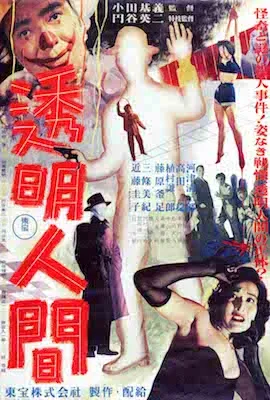
Invisible Man, or Tômei Ningen in the original Japanese (also known as The Invisible Avenger), was released on December 29, 1954, almost two months after the first Godzilla. Produced by Toho, it runs 70 minutes, filmed in black and white in 1.37:1 aspect ratio. It is the first entry in Toho’s informal “Transforming Human” series, later followed by The H-Man (1958), The Human Vapor and The Secret of the Telegian (both 1960). It is the second Japanese adaptation of the Invisible Man story and the second with effects director Eiji Tsuburaya’s involvement, after Daiei’s The Invisible Man Appears (1949). At times it feels less like an organic story and more like a highlight reel of “invisible man” effects techniques Tsuburaya didn’t get to use the first time around. It was directed by Motoyoshi Oda, a reliable director who typically handled up to seven films a year. Invisible Man was completed four months before Oda’s next film Godzilla Raids Again (1955) and only two months after his previous film Ghost Man (1954). The leads of Ghost Man, Seizaburo Kawazu and Miki Sanjo, return, along with composer Kyosuke Kami. In an interesting twist it was not produced by Tomoyuki Tanaka but by Takeo Kita, the art director behind dozens of kaiju eiga throughout the 1960s and 1970s.
The film opens with a compelling scene of an invisible man’s suicide. A driver in Tokyo traffic strikes an unseen obstacle; when a crowd gathers, a dead man materializes underneath the car. A suicide note indicates the deceased is a former soldier who became invisible through military science and that one more member of his invisible squad remains at large. “Invisible Man” paranoia settles over the nation, and unscrupulous dirtbags are eager to take advantage.
Yajima, proprietor of the Black Ship nightclub, his sleazy lieutenant Ken, and their gang of drug runners pull off a series of high-profile heists “disguised” as invisible men (let that sink in for a minute…). Yajima finally goes too far when he bribes an old night watchman into granting access to a dockyard. The heist succeeds, but instead of paying off the watchman, Ken kills him. Unbeknownst to the gang, the watchman was neighbors with the true last surviving invisible man in the same boarding house, and he’s not about to take the old man’s death lying down.
The cast behind these two-dimensional characters is actually pretty stellar. Seizaburo Kawazu plays the unassuming Nanjo, an invisible man disguised as a clown, whose sweet relationship with the girl Mari (Keiko Kondo) and her grandfather (Kamatari Fujiwara) forms the emotional core of the plot. Miki Sanjo plays nightclub singer Michiyo, while Kenjiro Uemura plays her imposing and threatening suitor Ken. Fuyuki Murakami appears in a rare non-scientist role as a scruffy newspaper editor. One of the best performances belongs to the always-great Yoshio Tsuchiya as a reporter hot on the trail; his scenes with the invisible Kawazu are superbly acted, with Tsuchiya convincingly performing against nothing. Minoru Takada is a little disappointing as the clichéd gangster boss Yajima, though he gets a significant (but goofy) fight scene in the climax. Contract supporting actors fill multiple roles as patrons, commuters, and detectives; literally, a large number of them have multiple parts across the film’s runtime. An honorable mention goes to Noriko Shigeyama as the nightclub dancer.
As with The Invisible Man Appears, Tsuburaya depicts the invisible man with a variety of special techniques, though physical props are less prominent. We still get a piano that plays itself and eerie footstep effects in loose sand, but a fair amount of the newer effects were filmed separately and composited so they appear to be floating e.g. Nanjo reviewing a checkbook for clues, instruments playing themselves at the nightclub. A lengthy climax chase features a self-driving moped with some pretty obvious wirework. The reveal scene is slower than the classic bandage flurry: Nanjo cleans off his makeup, revealing nothing underneath. Kawazu is filmed against a black backdrop in full clown makeup, wiping black paint on top of it so that after compositing the makeup disappears into the background. The principle is the same as earlier invisible man films, and the effect remains one of the film’s highlights.
Despite quibbles with plot and characterizations, this is a pretty well-directed film. Oda leans into the thriller aspect with key moments of tension, such as when commuters realize an invisible man is among them, or Nanjo stealthily pursuing Yajima and Ken into the cellar of the Black Ship. The score by Kyosuke Kami, known for his jazzy soundtracks, shows restraint that greatly enhances the atmosphere.
Invisible Man is a mishmash of genres — suspense, mystery, crime thriller, horror, and romance — yet presents very little science fiction. A single expository scene describes how the invisible men were created; after that it turns into a kind of “invisible man superhero” story with no moral lesson or ethical quandary. This stands in stark contrast to Daiei’s earlier The Invisible Man Appears, which carried a clear moral, depicted the birth of the invisible man, and functioned as a slightly better crime thriller with more interesting characters.
In the final analysis this is an inferior Invisible Man story compared with The Invisible Man Appears. However, it avoids the fatal mistake of being a dull movie and can actually be quite entertaining despite its faults. That this cast and crew churned out the film in only two months really underscores their professionalism and talent. I rate it 3 out of 4 stars.