Review
The Invisible Man Appears
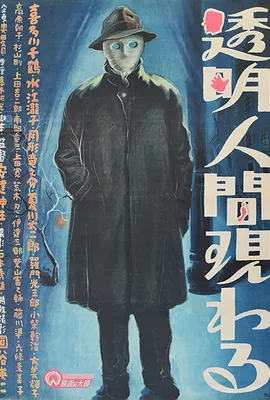
The Invisible Man Appears (Tômei Ningen Arawaru) was released on September 25, 1949, making it one of the earliest science fiction films out of Japan, predating the first Godzilla film by a full five years. It was produced by Daiei, the studio that would later release the first color science fiction film, Warning from Space (1956), and would become famous for its Gamera and Zatoichi films of the 60s and early 70s. It runs 82 minutes, filmed in black and white at 1.33:1 aspect ratio. This is the first Japanese film based on the classic character introduced in H.G. Wells’ 1897 story The Invisible Man, following Universal’s celebrated 1933 adaptation starring Claude Rains. It was written and directed by Nobuo Adachi, based on a story by prolific mystery writer Akimitsu Takagi. The film’s special effects were supervised by Eiji Tsuburaya, who had recently been forced out of Toho under pressure from the US Occupation over his wartime propaganda work. Tsuburaya expressed interest in Daiei’s invisible man film and agreed to join the production; without his involvement, it’s unlikely the film would have ever been greenlit. He eventually returned to Toho, where two months after the release of Godzilla (1954), he took another crack at the concept in Motoyoshi Oda’s Invisible Man, aka The Invisible Avenger.
The film’s plot covers a lot of ground during its sparse 80-minute runtime. It begins in the laboratory of Dr. Nakazato, where the elder scientist observes the rivalry between his two understudies, Drs. Seki and Kurokawa. The two men are rivals in science and romance, competing to see who will be the first to discover an invisibility serum, with the grand prize being Nakazato’s daughter, Machiko. Unbeknownst to either of them, their mentor has already secretly perfected a formula. Nakazato later demonstrates it for his business friend Kawabe, who surreptitiously notes where the formula is hidden. Shortly after, Nakazato disappears, leaving a note explaining that he is preparing to test the formula on himself. Kurokawa goes searching for him and also vanishes. Then an invisible man storms into a jewelry store and attempts to steal the Tears of Amour, an extremely valuable diamond necklace that Kawabe also has his eye on. What follows is a tense crime mystery (screenwriter Takagi’s specialty) with strong noir influences, where secrets are revealed, villains are unmasked, and what began as a playful rivalry between fellow scientists tumbles inexorably toward tragedy.
The film progresses at a brisk pace, deftly whisking the viewer from scene to scene without lingering too long or moving too fast — with a few exceptions. The flashback portraying the birth of the invisible man seems to rush through monumentally consequential decisions, and toward the final act the editing grows jumpy enough that you lose track of where certain characters are supposed to be, particularly the invisible man himself. In the closing minutes he survives two attempts on his life before finally meeting his demise in a shootout with the police, with no indication he survived the previous attempts until he literally appears out of nowhere to continue his mischief.
Adachi’s direction is competent, making ample use of first-person perspective to show the invisible man’s progress through a scene — a cheap in-camera trick that saves on special effects. The acting all around is decent, with Shosaku Sugiyama’s slimeball Kawabe the clear standout, stealing nearly every scene he’s in. Daijiro Natsukawa also gives a strong performance as Dr. Seki. One of the best acted scenes occurs between him and Chizuru Kitagawa’s Machiko: Machiko carries on nonchalantly while Seki fidgets and anxiously tries to deflect her attentions, because he knows the jealous invisible man is in the room with them. Dr. Nakazato is played by Ryunosuke Tsukigata in a scientist role far less interesting than his better-known work elsewhere (see Sanshiro Sugata [1943]). The most intriguing supporting character is Dr. Kurokawa’s actress sister, Ryuko Mizuki, played by Takiko Mizunoe, donning her distinctive short haircut. Ryuko is introduced when the other characters attend her revue, and a brief montage highlights Mizunoe’s real-world talents, including singing, dancing, and swordplay. She also proves indispensable to the plot, rescuing the Tears of Amour, tricking the true villain into revealing himself, and infiltrating the villain’s hideout to rescue the kidnapped Dr. Nakazato. Daiei stalwarts Shozo Nanbu and Saburo Date have small roles as well; both would appear more prominently in the Zatoichi films.
The invisible man is realized through elaborate wirework and custom props: chairs with cushions that depress as if sat upon, pianos with keys that play by themselves, floating cigarettes and guns, self-driving motorcycles, and the like. While the floating guns have that telltale wobble betraying the trick, other effects — such as a stool raised in anger and held ready to strike — are executed swiftly and forcefully, with shocking results. The unwrapping scene follows the 1933 Universal film almost beat for beat, but with more movement and intensity, which unfortunately fouls the end result. Obvious matte lines and brief moments of “disappearing” cloth betray the black-velvet-suit technique behind the effect, but it’s certainly a valiant effort.
The score was composed by Goro Nishi, a veteran composer active throughout the 30s, 40s, and 50s. Nishi’s music is nearly a perfect match for the film; my only complaint is that the cue for the invisible man is repeated far too often, to the point where it loses its effectiveness and even starts to grate on the ears.
In the final analysis, this was an overall enjoyable film, with only a few complaints regarding editing and music. The effects serve the story nicely and almost all the performances are terrific. The story itself is competently written and executed; although certain reveals are predictable, the film wisely refrains from telegraphing them too strongly so that there’s always some element of uncertainty until the final scenes. I rate this film a solid 3 out of 4 stars.