The Invisible Man vs. The Human Fly
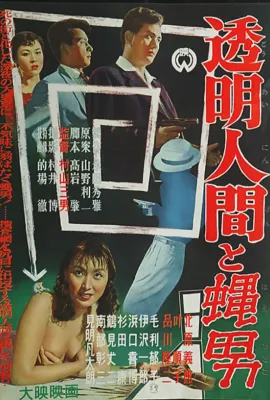
The Invisible Man vs. The Human Fly, or Tômei Ningen To Hae-Otoko in the original Japanese, was released on August 25, 1957. It was produced by Daiei, runs for 96 minutes, and was filmed in black and white in 1.37:1 film aspect ratio. This was Daiei’s second Invisible Man film after 1949’s The Invisible Man Appears, though this time without the involvement of effects director Eiji Tsuburaya. It was released in the same year as the English language short story The Fly by George Langelaan, and it just barely predates the 1958 American sci-fi film of the same name, making it possibly the first “human fly” film ever made. It was produced by Hidemasa Nagata, who would later produce several entries in Daiei’s Gamera series.
The film opens with an inexplicable murder committed aboard a passenger plane in flight, but with no perp in sight. It is the latest in a string of murders linked only by the fact that they are “unsolvable.” The lead detective on the case, Wakabayashi, doggedly pursues any and all leads. He learns about cutting edge advancements in “invisibility” research, although it has fatal side effects for humans and therefore cannot explain the crimes. Eventually the threads converge on Kusunoki, a vindictive war vet who previously served in a chemical division, and is using his stock of “human fly” serum to target his perceived enemies. As the body count piles up and Kusunoki evades capture, it seems like the only thing that can swat the human fly may just be an invisible man. But who will take the risk?
The cast is led by Yoshiro Kitahara, an up-and coming fresh face who had been with Daiei since 1953. He is more familiar to genre fans as Toshiro’s father in the original Gamera (1965), and had supporting roles in several Gamera sequels. Another familiar face is Shozo Nanbu as Dr. Hayakawa. Nanbu had appeared in Daiei’s prior invisible man film The Invisible Man Appears as well as Warning from Space (1956), and would continue appearing in Daiei productions regularly throughout the 60s. Bontaro Miake and Koichi Ito also appear. Miake was last seen as one of the lead scientists (along with Nanbu) in Warning from Space, and both actors later played officials in Gamera vs. Barugon. Junko Kano, Ryuji Shinagawa, and Tsurumi Joji round out the main cast of protagonists as Hayakawa’s daughter, protege, and lab assistant respectively. Yoshihiro Hamaguchi gives a strong performance as Wakabayashi’s doomed assistant detective. Kitahara certainly holds his own, but the memorable performances are given by the film’s villains, including Ichiro Izawa as Kusunoki and Shizuo Nakajo as Yamada, Kusunoki’s hopelessly vile hitman. Nakajo’s threatening performance, as a lecherous miscreant slowly driven mad by his addiction to the fly serum, is only slightly undercut by some primitive “fly man” effects that kill the tension.
The human fly is mostly heard rather than seen, suggested by a buzzing sound effect when the villain is close at hand. When seen, though, he looks like a clumsy compositing trick, an actor dangling from a wire, and in some shots a literal toy doll. The only real “power” of the human fly is to grow or shrink, an effect achieved by a simple dolly zoom comped onto the background. The invisible man effects are nothing particularly new, or at least nothing we haven’t already seen in The Invisible Man Appears or in Toho’s Invisible Man (1954). In fact there are actually very few effects in this regard. Invisible people sit on chairs and peel bananas, and that’s about it. Otherwise it’s pantomime fight scenes or more dramatic scenes filmed with no one in frame. One of the characters who turns invisible leaves their face exposed, a floating head effect leading to some unintentionally humorous shots.
The Invisible Man vs. The Human Fly was directed by Mitsuo Murayama. This appears to be an early work of his, and he later had an extensive career making war films and working with the Shaw Brothers. He was also slated to direct the infamous unmade rat monster film Nezura before it was canned. His invisible man film is basically a police procedural with a science fiction twist. The camaraderie between the detectives, deftly handled by Kitahara and co-star Hamaguchi, could power its own film completely separate from any sci-fi elements. In fact, it’s those very elements that make this film feel inconsistent and awkward. The topic of the invisible man is introduced as an unnatural aside comment by the detectives during a house call on the scientists. The human fly theory is first floated by Hamaguchi’s character as a possible explanation for the buzzing sound at the crime scene, and it turns out to be the luckiest guess of the movie. The silly effects and subject matter also belie the fact that this is an extraordinarily violent movie. The human fly claims at least a half a dozen victims, and most of those murders occur in the first half of the movie. The body count is so high that by the final act you’re wondering who’s even left. And yet, after everything has transpired, the film still somehow manages to end on a happy, even lighthearted note, completely at odds with what transpired.
Overall I rate The Invisible Man vs. The Human Fly 2 out of 4 stars. It has its good suspenseful moments, and Kitahara is a solid lead. If it were more consistent, if it could find the right balance between it’s violent and humorous qualities, it’s police procedural and its science fiction plot points, it might have been a “good” film. As it stands, the combination of arbitrary violence, unconvincing plot devices, silly effects, and the incongruent ending lead me to label it just an “okay” film.