Review
The Men Who Tread on the Tiger’s Tail
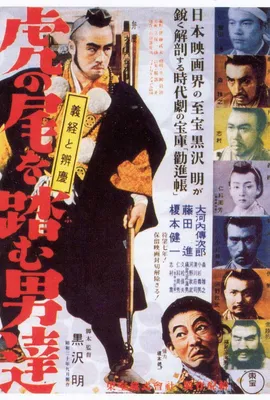
The Men Who Tread on the Tiger’s Tail, or Tora No O o Fumu Otokotachi in the original Japanese, was released on April 24, 1952, although it was actually completed much earlier, in 1945. It was produced by Toho, runs for 59 minutes, filmed in black & white and in standard Academy film aspect ratio. The film’s concept was pitched to Toho by director Akira Kurosawa, after his planned historical epic was canned due to a “horse shortage.” Kurosawa offered to replace the canceled film with an adaptation of the famous kabuki play Kanjinchô, based on the historical episode of the samurai Yoshitsune’s flight from his vengeful brother Yoritomo in the 12th century. Kurosawa promised a script in under three days, a single exterior shooting location, and a single set. Lead actors Denjiro Okouchi and Kenichi Enomoto had been slated to appear in the canceled film, so Kurosawa pivoted and wrote his new script specifically for them. Kurosawa delivered a tight script, and a short but wildly entertaining film, powered by the combined performances of Okouchi and Enomoto. During production, Japan surrendered and WWII ended, precipitating a sequence of events which delayed the film’s release for seven years. American occupation forces moved in and began rooting out vestigial militaristic influences, leading to the dismissal of the film censors ensconced in Toho studios. Their last defiant act before disappearing into irrelevance was to sabotage their sworn enemy — Akira Kurosawa — by failing to report his latest film to the American censors, causing it to be banned as “unreported.” Eventually the American censors re-reviewed the film and apparently enjoyed it enough to approve its release in 1952.
The film’s story begins with a troupe of itinerant monks traveling towards the border between provinces in 12th century Japan. Their porter, an impish but shrewd man, realizes that he is escorting famed samurai Yoshitsune and his retainers, who are traveling in disguise. Yoshitsune had earned fame in a prior military victory, but his rising star threatened his brother Yoritomo, who ordered his arrest. Yoshitsune seeks refuge with his ally across the border, but they must first pass through a guarded checkpoint. The porter warns them that their adversaries have already guessed their scheme and are expecting them. The story culminates in a tense exchange at the checkpoint where Yoshitsune’s chief retainer Benkei must inhabit his role as a Buddhist monk and bluff his way through the encounter.
The film rests on the performances of Denjiro Okouchi as Benkei, Yoshitsune’s wily and gruff right hand man, and Kenichi Enomoto as the porter, a part not present in the Kanjinchô play and which was created specifically for Enomoto by Kurosawa. The scene where Benkei skillfully navigates the interrogation at the checkpoint is mighty fine work from Okouchi, but it is Enomoto that makes the film such a joy to watch. Enomoto’s antics, his mannerisms and especially his expressions, are carefully measured to deliver maximum entertainment without being irritating. He also serves as an avatar for the viewer, since his character is an accidental observer swept up in and overtaken by the unfolding story. (Ironically it was Enomoto’s inclusion in the film that so irked the Japanese censors; they thought it was “disgraceful” to the original play to give such a prominent role to a comedian.) The cast is stacked with Kurosawa regulars, including Takashi Shimura, Masayuki Mori, Akitake Tono, and Susumu Fujita, but they are scenery compared to the tour de force of Okouchi and Enomoto.
The music in the film is split between a sparse score and what sound like recitations of folk songs or poems recounting the historical incident of Yoshitsune’s flight — one of many elements that make the film feel much more like a stage production than a truly “cinematic” experience, and contribute to its unique identity. A similar tactic was used in Kurosawa’s later film Throne of Blood (1957). The score was composed by Tadashi Hattori (no relation to the Hattori dynasty of composers established by Ryoichi Hattori), and only comes to the fore during a few of Benkei’s exchanges during the interrogation scene. Hattori wisely allows the music to play second fiddle to Okouchi’s performance.
Given that this is a pretty static film — most of the action occurs on a single set with all the actors seated in a fixed arrangement — there’s not much opportunity for Kurosawa to flex his artistic talents. It’s the screenplay that does the heavy lifting here. It’s no action adventure like The Hidden Fortress (1959) or Yojimbo (1961), nor is the screenplay particularly compelling like Rashomon (1950, although that is admittedly a high bar). It’s not even a Kurosawa original: it’s based on a kabuki play which is itself based on a noh play (one of Kurosawa’s most favorite art forms). But it has an unmistakable something that makes it interesting. And if there is a thesis statement for this film, it’s that it’s interesting. (My sole complaint is that the drinking party that caps off the film runs a bit long.)
Kurosawa recounted in his autobiography that, after defeating the arguments of the impotent Japanese censors, one censor confronted him and accused the film of being “boring” and “uninteresting.” Kurosawa responded with a banger for the ages: “If a meaningless person says something is meaningless, that’s probably proof that it isn’t meaningless; and if a boring person says something is boring, that’s probably proof that it’s interesting.” He got the last laugh because an American film censor (i.e. not a boring person) thought this film interesting enough to warrant a release, and while The Men Who Tread on the Tiger’s Tail is overshadowed by Kurosawa’s later triumphs, it’s still a 4-star film in my book.