Review
The Most Beautiful
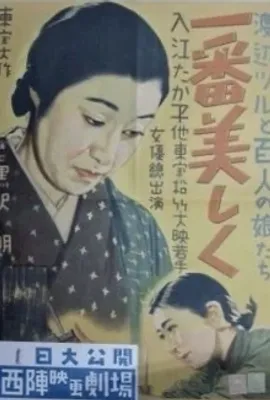
The Most Beautiful, or Ichiban Utsukushiku in the original Japanese, was released on April 13, 1944. It was produced by Toho, commissioned by the Information Bureau as a wartime propaganda film, runs for 85 minutes, and was filmed in black and white in standard Academy film aspect ratio. It is the second directorial feature by revered director Akira Kurosawa, following immediately after he completed Sanshiro Sugata the year before. Kurosawa was originally approached by the Information Bureau to direct a propaganda film touting the prowess of Japan’s feared Zero fighter jets. However, given the late stage of the war and the deterioration of Japan’s naval capacity, securing planes for filming became an impossibility, and the concept was scaled down to a lens factory instead. Filming took place throughout 1943, so by the time the film was actually released in 1944, the war situation was even more dire for the Japanese.
The film centers on a contingent of female workers at the Nippon Kôgaku lens factory. The factory management has initiated an emergency period of increased quotas: 100% for male workers, 50% for female workers. The female staff are disgruntled, and express to management that they resent being viewed as so much less capable than the men, and ask for at least 66%, or two-thirds increase in quota to demonstrate their resolve. Management concedes, entrusting the girls to the leadership of Tsuru Watanabe, their most senior member, and Mizushima, their dormitory mother. At first the girls make steady progress towards their lofty goal, but soon encounter difficulties arising from illness, injury, troubles with distant family, and spats between workers fueled by exhaustion. Tsuru herself is not immune to these troubles, burdened by her responsibility of maintaining discipline among the ranks while quietly suffering through her own familial crisis.
The cast is led by Yoko Yaguchi as Tsuru. She naturally suits the part of a tough leader, her stern features emphasized by the absence of makeup or other styling. Kurosawa insisted that the female cast forego any preparation involving hair and makeup in order to make them appear and act more genuine on film. Yaguchi was also a naturally headstrong and stubborn personality, both in character, holding her ground against the factory managers, and off camera, where she often clashed with Kurosawa regarding his treatment of the cast during production. In a twist of fate, a year after The Most Beautiful, Yaguchi retired from acting and married Kurosawa, and they remained married until her death in 1985.
Supporting Yaguchi is a literal troop of female actors, all put through the strict regiment to familiarize themselves with the work and living conditions of factory workers. The film was released without any credits whatsover (a wartime measure to conserve film stock), so what names we have available are derived from other resources, such as Toho’s internal records, Kurosawa’s memoirs, and various interviews and film databases. Furthermore, several of the actresses quit acting afterwards, possibly in reaction to the harsh filming conditions. Suffice to say, at least four faces among the troop are noteworthy for their performances. Asako Suzuki plays Suzumura, a rural girl who develops a fever and is reluctantly brought home by her strict father to recover. Shizuko Yamaguchi plays Yamaguchi, another girl who frequently runs high fevers, but has Tsuru hide her condition from Misuzhima so that she can stay on the production line. And Itoko Kono and Toshiko Hashima play Okabe and Hattori, respectively, two girls whose simmering feud boils over when Okabe is overcome by exhaustion and resents Tsuru’s gentle treatment of Yamaguchi, mistaking her leniency for favoritism.
Takako Irie fulfilled the role of the dorm mother both on and off screen; she was instrumental to maintaining cohesion and discipline among the young actresses, who were unused to the working conditions Kurosawa foisted upon them. Takashi Shimura, Soji Kiyokawa, and Ichiro Sugai play the factory managers. All three actors had previously appeared in Sanshiro Sugata in supporting roles, and Shimura in particular would appear in many more Kurosawa films to come. Unpei Yokoyama is charming as the elderly janitor and gardener at the dorm, and Jun Maki has a notable appearance as Suzumura’s father, who comes to retrieve her after she falls ill. Maki has no dialogue, but does have a humorous moment trying to politely acknowledge every girl in the dorm crowding the entrance.
The film’s music is almost entirely composed of working songs performed by the girls while marching back and forth between the factory and the dorm, sometimes sung, other times performed on fifes and drums. Otherwise there’s no score to speak of and no known composer credit. Kurosawa continues to show off some innovative camerawork and editing. Quick successive cuts of Tsuru in the same spot holding different poses help depict the passage of time in a few moments. The camerawork is particularly effective during a scene when one of the girls slips off the dorm roof while drying laundry. But moments like these are few and far between, as most of the film adheres to a documentary style of filming, not unlike that of Kurosawa’s contemporary Ishiro Honda.
The thesis of the film, the thing which it describes as The Most Beautiful, is a tireless spirit that pursues excellence and puts the victory of the nation over all else, including duties to one’s family or even one’s health. At the end of the film, when Tsuru denies an offer to take leave of the factory to return home and grieve for a deceased parent, Mizushima says of her that she has become a “truly kind girl” and “beautiful.” But there is an apparent contradiction between the end of the film where this is expressed and the very beginning of the film. The first scene is a public address of the factory by Takashi Shimura, advocating for workers to exemplify and uplift the Japanese spirit, a chief tenet of which, Shimura notes, is “reverence for ancestors,” which presumably includes parents. There is a tickle of satire here: the outcome of the production surge to prop up a failing Navy in the last stages of a futile war is a selfless, efficient worker, who has also sacrificed the very Japanese spirit she was previously urged to inculcate.
Despite the austere working conditions and the contention with female cast, Kurosawa once claimed that The Most Beautiful is “the most dear” to him of his repertoire. (One wonders if his fateful meeting with Yoko Yaguchi had anything to do with that appraisal.) As a propaganda film, I’m not sure it accomplishes its goal at all covincingly. Tsuru and the girls are like characters in a parable, with the girls demonstrating the different failure modes one can stumble into while Tsuru represents the model worker who has overcome those same pitfalls. Even so, the last shot of Tsuru shows she’s barely holding it together herself. One must ask, “is it worth it?” However, it is also a Kurosawa film, and the little character moments sprinkled throughout are a welcome relief from an otherwise dreary affair. I rate it 2 stars out of 4.