The Mysterians
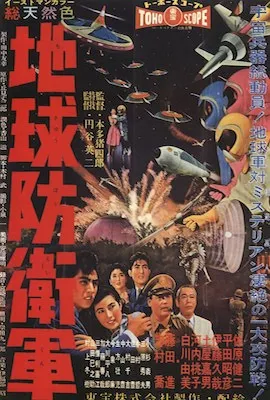
The Mysterians, or Chikyû Bôeigun (Earth Defense Force) in the original Japanese, was released on December 28, 1957. It was produced by Toho, runs for 88 minutes, filmed in color and shot in glorious TohoScope at 2.35:1 film aspect ratio. This would be Toho's most ambitious effects film to date, an epic feat of special effects wizardry and cosmic storytelling brought to life by the tokusatsu dream team of director Ishiro Honda, effects director Eiji Tsuburaya, and composer Akira Ifukube. It was based on an unpublished novel by author Jojiro Okami, which was fashioned into a screenplay by Shigeru Kayama, author of the original Godzilla novellas, and Kaoru Mabuchi, under the pseudonym Takeshi Kimura.
The film opens with a village festival at the foot of Mount Fuji. Two scientist friends, Atsumi and Shiraishi, are on a double date with their sweethearts, Etsuko and Hiroko. The village is devastated by the 1-2-3 punch of a freak forest fire, an earthquake, and a giant robot attack, and Shiraishi goes missing. A group of aliens, known as the Mysterians, take up residence inside a large dome at the base of Mount Fuji. They profess to be refugees from a nuclear war on their own planet and want to resettle on Earth. They boldly demand a permanent plot of land and the right to intermarry with Earth women to repopulate their species. War breaks out, and the Mysterians have the early advantage due to their superior technology, but it's only a matter of time before human cooperation and ingenuity cut them down to size. Meanwhile, Atsumi learns that Shiraishi has joined the aliens, and so he must not only defeat the aliens but rescue his colleague from their seductive ideology.
The cast is led by genre regular Kenji Sahara, in his second pairing with leading lady Yumi Shirakawa. They previously appeared together in Rodan (1956) and would again appear in The H-Man (1958). In this film, Sahara gets to play a more dashing, dynamic figure as Atsumi, as opposed to Rodan, where he spent half the film as a convalescing amnesiac. Akihiko Hirata plays his third scientist in as many tokusatsu films, and his second tormented scientist who also happened to be dating Momoko Kouchi, after Serizawa in the original Godzilla (1954). This would be Kouchi's final sci-fi film before returning to acting school; she would not reappear in the genre until Godzilla vs. Destoroyah (1995). Yoshio Tsuchiya plays the conniving leader of the Mysterians, and while he immersed himself in the role, his performance is smothered by his costume. He would fare far better as the leader of the X-seijin in Invasion of Astro-Monster (1965). The supporting cast is stacked with familiar faces from the Toho lot, most notably Takashi Shimura as Atsumi's mentor, and the English-speaking "actor" Harold Conway, making his first appearance in the genre.
The special effects of The Mysterians are a leap forward for Tsuburaya's crew, including their most ambitious set pieces at the time. Early demonstrations of Mysterian power, including melting tanks with high temperature lasers or swallowing them whole in dirt whirlpools, are particularly notable. The Mogera robot, while an instantly iconic design, is a forced addition to the film; the first such case of producer Tanaka mandating giant monsters where they didn't really belong. (Mogera would return in Godzilla vs. SpaceGodzilla in 1994.) We also get the Marcalite FAHPs, the first in a long line of "maser" based weaponry that would become a genre staple. The interior shots of the Mysterian dome, with alien crowds rushing along catwalks and zooming past on elevators, remain some of the best effects shots produced in this decade. The film's most jarring shots are a handful of poorly processed blue screen closeups during the tank scenes.
Maestro Ifukube gives us one of his most recognizable battle themes. He apparently never reused this one (like he would with so many others), so it remains indelibly linked to this film. The studio orchestra's efforts to imbue Ifukube's music with the appropriate energy are sadly undercut by some questionable editing choices, resulting in a final battle sequence where the music is literally chopped to pieces.
Honda's direction is solid, although his handling of the aliens themselves is pedestrian and leaves much to be desired. (No dramatic reveals here, they're just kinda there.) It's no secret that Honda favors scientists over soldiers in his films, especially when dealing with a conflict that requires international cooperation. In The Mysterians however, he sets up an intriguing dichotomy. On the one hand are Earth's scientists, who are peace-loving but naive, and on the other are the Mysterians themselves, who are cunning, deceitful, and prey on that naivety. They caused the nuclear holocaust that destroyed their home planet, yet they feel entitled to forcibly take over Earth because they're smarter than your average Earthling. So for all of Honda's pontificating about the noble pursuit of science, he's at least aware of its potential for misuse and abuse.
Overall I rate The Mysterians 3 out of 4 stars. Compared to its predecessor Rodan, it's clearly a leg up in production value and scale, but it's lacking in emotional content, like romance, suspense, and dread, that make Rodan the superior film. That said, The Mysterians' legacy is firmly set in the pantheon of great tokusatsu films. It was the first of Toho's ambitious space films, later followed by Battle in Outer Space (1959) and Gorath (1962). It was cited as an influence by prominent effects film director Shinji Higuchi (Gamera trilogy [1995-1999], Shin Godzilla [2016]), and the phrase "Earth Defense Force" is ubiquitous throughout derivative sci-fi works in both film and television.