Prince of Space
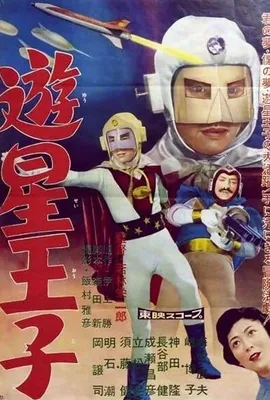
Prince of Space, or Yûsei Ôji ( Planet Prince) in the original Japanese, was released on May 19th, 1959. It was produced by Toei, runs for 57 minutes, and was filmed in black and white in 2.35:1 film aspect ratio. The “Prince of Space” character was originally created by Toei to compete with Shintoho’s “Super Giant” character of the same time period, and prior to this feature he had already appeared in year-long, 49 episode television series. It was directed by Eijiro Wakabayashi, from a script by Shin Morita, and features a score by Katsuhisa Hattori (father of future Godzilla composer Takayuki Hattori). Prince of Space and its immediate sequel, The Terrifying Spaceship, both debuted in May 1959 within a week of each other, and are reputed to be Toei’s very first science fiction theatrical films.
The story follows Waku, a lowly shoe shiner, and his immediate circle: the children under his care, and the scientist Dr. Maki, inventor of a revolutionary rocket fuel that will propel mankind into the space age. An interstellar despot, Ambassador Phantom, learns about the rocket fuel and threatens Earth with destruction if they do not hand it over to him. Unbeknownst to his friends, the unassuming Waku is none other than the Prince of Space, a sort of space sheriff, whose own strength and personal arsenal are more than a match for Phantom and his goons. Phantom resorts to more subtle methods to accomplish his schemes, but the Prince’s friendly alliance with the children help him stay one step ahead. Finally the Phantom attempts to abduct Dr. Maki himself, leading to a final showdown on the launchpad of Maki’s experimental rocket.
The cast is led by Tatsuo Umemiya in the role of Waku. He’s certainly hero grade material, and fits role of a children’s super space hero like a glove. He is undermined though by a children’s grade script, and costume as well. The trio of kids, played by Akira Asami, Koji Komori, and Midori Tsuzuki, fare pretty well for themselves. Joji Oka plays the cackling, hook-nosed, vain Ambassador Phantom, with all the attendant theatrics and zero nuance. The rest of the adult cast, while not terrible, don’t really stand out, with one major exception. A side character, Shibasaki, is abducted and hypnotized by Phantom in an attempt to steal the formula for Maki’s rocket fuel. Shibasaki is played by Masahiko Naruse, who would go on to play exceptionally sinister and creepy roles in the Ultra franchise. Prince of Space offers an early glimpse of his unsettling talents.
For a tokusatsu film there’s actually not very many special effects shots in Prince of Space. There are a few scenes of spaceships, such as when Ambassador Phantom and Prince make their grand appearances, and of course there’s Dr. Maki’s rocket on its launch pad. Phantom’s ship in particular appears to resemble the Gotengo from Toho’s Atragon, despite predating that film by 4 years. A miniature set of the Tokyo skyline appears early on, with Tokyo Tower casting an obvious shadow on the painted backdrop. And there’s a brief shock when Phantom lashes out at the policemen surrounding his ship. The majority of the action in the film plays out more like a Super Sentai episode than an epic science fiction film, with actors in gaudy costumes chasing and fighting each other through abandoned structures. Prince takes pot shots at Phantom’s goons, shooting low-quality “lasers” while they cower and jump in fright. At one point Phantom calls up a “subterranean vehicle” to tunnel in close to Maki’s laboratory, but the vehicle itself is never seen; Phantom’s underground journey conveniently occurs off-camera. Most of the budget appears to have gone into the fantastic rocket explosion at the film’s climax, easily the best effect of the film.
The score is nothing to write home about, mainly because there’s so little of it in the sparse runtime. A few cues here and there to underscore tension, and some generic action music during the fight scenes. The most prominent musical cue is the children’s song extolling the title character which bookends the film. Wakabayashi’s direction is fine, considering the material. At its heart Prince of Space is children’s entertainment so there aren’t any grand themes or morals present, or at least nothing subtle. It’s quite clear who the good guys and bad guys are, and no matter how strong the bad guys, the good guys are always stronger, and always win.
Overall I’d give Prince of Space 2 out of 4 stars. Yes, it’s a character meant for children, it’s based on a children’s TV show and plays like an extended TV episode. But so were later Toei tokusatsu shows like Kamen Rider and Super Sentai, and of course the Ultraman franchise, and each of those programs were much more engaging in terms of story, music, effects and performances. Prince of Space, by comparison, just feels “okay.”