Rodan
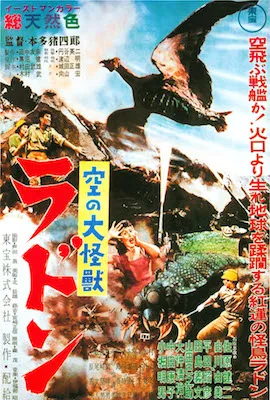
Rodan (Sora no Daikaiju Radon, aka Giant Monster of the Sky Rodan) was released on December 26, 1956. It was produced by Toho, runs 82 minutes, filmed in color at 1.33:1 aspect ratio. While not the first color science fiction film out of Japan — Warning from Space beat it to the punch earlier that year — it is the first in Toho's repertoire. This was Toho's third kaiju eiga, after Godzilla (1954) and Godzilla Raids Again (1955), and its first not to feature Godzilla, instead marking the debut of Rodan, who would later become a stalwart Godzilla ally and remains a series fixture to this day. The film reunites much of the Godzilla crew — director Ishiro Honda, composer Akira Ifukube, screenwriter Takeo Murata, and effects director Eiji Tsuburaya — with Takeshi Kimura making his kaiju eiga debut on the screenplay. It stars Kenji Sahara and Yumi Shirakawa, the first of three 50s Toho sci-fi films to cast them as a romantically linked couple, alongside The Mysterians (1957) and The H-Man (1958). Producer Tomoyuki Tanaka, riding the success of the first two Godzilla films, was inspired by the supersonic jet craze to craft a film about a flying monster and its clash with civilization. The story is based on an original work by Ken Kuronuma, author of many stories exploring paranormal phenomenon — in other words, a good fit for a kaiju film.
The film starts in a mining village at the foot of Mt. Aso. A flooded tunnel yields a floating, bloodied corpse, and Goro, another miner who had quarreled with the victim, has vanished — making him the prime suspect. Shigeru, the safety inspector, consoles Goro's sister Kiyo as more miners are victimized. The true culprit proves to be a giant prehistoric insect armed with razor-sharp claws. Shigeru leads police and army into the mine to dispatch it but is trapped in a cave-in. Shigeru is recovered after an earthquake opens a valley near Mt. Aso, but is traumatized, mute, and amnesiac. Meanwhile midair collisions, disappearances, and UFO sightings clog the airwaves until scientists stumble upon a theory so preposterous they can hardly believe it — until Shigeru regains his memory and confirms their worst fears: the flying reptile Rodan has been reawakened. Japan's fighter jets may not even keep up with Rodan's speed, and matters grow worse when a second Rodan joins the fray.
Like Godzilla Raids Again, Rodan departs from the original Godzilla's heavy-handed nuclear metaphor; global warming, not radiation, is the catalyst behind the monsters' appearance. Honda delves into suspenseful, downright horrific territory — the early mine scenes are among the gruesome highlights of the genre, aided by dark, ominous set design. Later kaiju films settled into brighter, tamer formulas, making Rodan's edgier tone a refreshing return visit. It does share Godzilla Raids Again's pacing problems: Rodan's attack on Sasebo is followed by another 15 minutes of film plus a lengthy missile bombardment climax, a structure later entries would refine (and put the monster fights at the climax).
Sahara and Shirakawa as Shigeru and Kiyo are terrific. Sahara especially sells the traumatized amnesiac angle, and at Toho he would eventually be known as "Mr. Tokusatsu" for his ubiquity in the genre. Akihiko Hirata returns as Dr. Kashiwagi, far more appealing than the cardboard scientist of Godzilla Raids Again, though his obsession with his pteranodon theory leads him to rent out an entire computer facility just to calculate the size of Rodan's egg. Yoshibumi Tajima makes his genre debut as a reporter and would go on to memorable appearances in Atragon (1963) and Mothra vs. Godzilla (1964). Suit actors Haruo Nakajima and Katsumi Tezuka both appear out of costume — Nakajima primarily occupied with playing Rodan but sneaking in as a military officer during the Sasebo attack.
The giant insect Meganulon looks ridiculous up close, but low light, music, and sound effects make the mine sequences far creepier than they have any right to be. The best Meganulon scene never shows the creature at all — victims are pulled into the flooded mine by an invisible force, Jaws-like in its restraint. Unlike the shark's reveal in Jaws, however, the Meganulon reveal prompts more derisive laughter than shock. Rodan follows a similar playbook, revealed gradually until scientists identify it from a close-up photograph. Modeled after known prehistoric reptiles rather than the stranger designs that would follow, this is Rodan's best look from the original series; his face was remodeled in the 60s to appear less feral and, dare I say, more goofy. Nakajima's first flying-monster suit work used piano wire from the rafters. Rodan flying under the bridge at Sasebo, while one of the film's highlights, was also one of the most dangerous to film; the supporting wires snapped and plunged Nakajima into the water tank. The hand-puppet Rodan face is virtually indistinguishable from the suit head, making its appearances far less jarring than in prior films.
The destruction of Sasebo is a tour de force — buildings, trains, and jeeps demolished by gusts from Rodan's wings, including a gas truck careening into a storefront and a building shredded by a mini tornado. The finale bombardment of Mount Aso runs long, with some explosions so large they reveal the wooden frame underneath the crater set, but the lava flow is unforgettable. The effects staff poured molten iron from a furnace onto the set, and the was heat so intense the crew fled to the opposite side of the stage and one of the cameras was destroyed. The heat caused both Rodan marionettes to malfunction and plummet into the flames; when wires snapped mid-rescue, the staff reworked the ending to make it appears as though the creatures would rather die together. Their demise, observed by the main cast, lit by volcanic fire, and backed by Ifukube's climactic cue, ranks among the genre's greatest finales.
Ifukube's score delivers the monster attack theme during Sasebo's destruction and a companion chase theme for the jet pursuit — later reused in Godzilla vs. King Ghidorah (1991). The city-destruction editing is choppy, a problem that would also plague The Mysterians the following year, but the main title theme is the true highlight: a powerful, eerie slow march whose snippet would later expand first into the title theme for Varan the Unbelievable (1958) and then into the classic Rodan theme. This theme accompanies the hatching scene, where the set design, lighting, effects, music, and Sahara's performance combine into the film's best moment.
In the final analysis, while not without its shortcomings, Rodan is clearly a standout entry of the genre — the first Toho kaiju film to deliver a genuine thrill, made while the filmmakers still had freedom to take risks before the genre settled into formula. Cheesy giant insects and pacing problems aside, the end product is greater than the sum of its parts. I rate it 4 out of 4 stars.