Review
Sanshiro Sugata
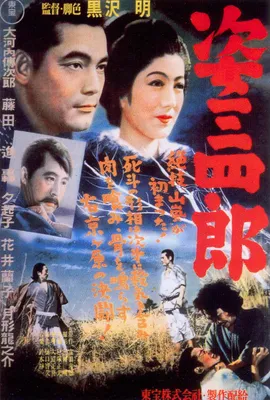
Sanshiro Sugata, or Sugata Sanshirô in the original Japanese, was released on March 25th, 1943. It was produced by Toho, ran for 97 minutes, and was filmed in black and white in standard Academy film aspect ratio. It was based on the novel of the same name by Tsuneo Tomita, itself a dramatic retelling of the rivalry between different schools of judo martial arts during the Meiji Era. This was the first feature ever helmed by acclaimed director Akira Kurosawa, who had just barely finished his apprenticeship at the time and was especially eager to sink his teeth into the tale of Sugata. Unfortunately for Kurosawa, the finished film was later heavily edited by wartime Japanese censors and about 17 minutes were lost. For decades, this edited version was the only version available, and it is the version that was released in the US in the Eclipse box set of The First Films of Akira Kurosawa. However, in 2026, a new 4K transfer was prepared which restored 12 minutes, bringing the film’s length back up to 91 minutes, though with crucial scenes still missing.
The story follows the journey of Sanshiro Sugata, a young martial arts disciple who joins the dojo of judo master Yano. Sugata is a promising youth with great strength, but is prone to violence and outbursts of temper. It’s up to Yano’s patient instruction to impart wisdom and patience to his protege. Yano’s unorthodox methods earn him the ire of several rival schools, and things come to a head when his dojo participates in an exhibition match for the Japanese police academy. Sugata is scheduled to spar with Murai, the father of Sayo, who he has just recently met and become infatuated with. On top of this, Sugata must contend with Murai’s zealous pupil Higaki, who is waiting in the wings for his chance to duel with Sugata and defend the honor of his dojo.
The cast is led by Denjiro Okouchi, as the dignified Yano, along with Susumu Fujita as the title character, and Yukiko Todoroki as the girl Sayo. Okouchi is well suited to the role of the fatherly mentor and teacher. He’s no stranger to physical stunt work, having risen to fame in the jidai geki genre on stage and film, and he gets to showcase his stunt work in an early scene of Sanshiro Sugata. Fujita is lovable as the earnest Sugata. It’s a refreshing look at an actor that would later become too comfortable playing one-note soldiers in any number of kaiju eiga films. Todoroki is charming as Sayo, and she and Fujita work brilliantly together to portray the budding romance between two shy youths. Takashi Shimura has a supporting role as Sayo’s father; the trajectory of his relationship with Sugata, from rival to friend to prospective father-in-law, is one of the most enjoyable parts of the story. Yoshio Kosugi and Kuninori Kodo make memorable appearances as an early rival of Yano (and later of Sugata) and as a priest, respectively. Kodo would later play a very similar role opposite Toshiro Mifune in Hiroshi Inagaki’s Samurai films of the 1950s. Finally we have Ryunosuke Tsukigata as the villainous rival Higaki. He looks and acts threatening in practically every shot he’s in, but that’s pretty much the entirety of his character. He makes for a rather unimpressive foil. When the final duel gets underway, we’re much more interested in the staging of the scene, set on a grassy hillside wracked by gale-force winds, then we are in any motivation of this character. Even his denouement is dealt with in flashback, off screen.
The music is composed by Seiichi Suzuki, and has two modes. One mode is the brutal title theme for Sugata himself, which occasionally softens and recurs in a major key when Sugata is having a spiritual epiphany e.g. while observing the water lilies in Yano’s pond at night. The second mode is the gentle, romantic tones accompanying Sugata’s and Sayo’s romance. Incidentally, both these scenes — Sugata clinging to a post in the pond waiting for his master’s forgiveness, and the fateful encounter between Sugata and Sayo on the temple stairs in the snow — are the best scenes in the film (I would even rate them better than the aforementioned final duel). Kurosawa’s sensitivity for visuals and his incredible sense for knowing when and how to move the camera through the scene are on full display. Ironically, the actual judo scenes — the very thing this film purports to be about — are among the least memorable, save for a handful of shots of the duel between Sugata and Murai. When the actors grapple, the action comes to a complete standstill, and there’s no sense of tension or anticipation of the next move. These have no instrumental accompaniment until the very end of the final duel; all the action takes place in utter silence.
As for themes, there are two main ones that stand out. One is the importance of understanding one’s sense of self and purpose and the value of one’s life in order to derive strength. The other is the appreciation of quiet spiritual devotion, praising it as a source of beauty. Naturally Sugata is the emblem of the former and Sayo of the latter. Among the scenes censored from the original release is a training scene between Yano and Sugata which further cements the theme of valuing life. At this point of the story, Sugata had inadvertently slain his last judo opponent and is crushed by guilt, and Yano literally beats the sense back into him to get him back on his feet. The absence of this scene is the most strongly felt of all the cuts made, and to my knowledge it has not yet been recovered, even in the 2026 restored version.
Sanshiro Sugata may not start off with a bang, but as the film progresses, from Sugata’s maturation as a martial arts master, to his budding romance with Sayo, the multilayered relationship with Murai, and the showdown with Higaki, the time spent investing in the premise, the characters and the setting pays off in spades. The heartwarming scenes of Sugata and Sayo alone justify viewing this film at least once. I rate it 3 stars out of 4.