Review
Sanshiro Sugata: Part Two
What I Liked
- Susumu Fujita.
- Ryunosuke Tsukigata redeems the Gennosuke character from the previous film.
- Kurosawa’s knack for writing characters.
What I Didn’t Like
- Intensely awkward antagonists.
- Unflattering portrayal of Americans.
- Dubious karate choreography.
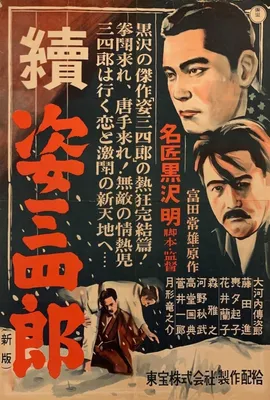
Sanshiro Sugata: Part Two, or Zoku Sugata Sanshirô, the “Continued Sanshiro Sugata,” was released on May 3rd, 1945. It was produced by Toho, runs for 83 minutes, and was filmed in black and white in standard Academy ratio. This was the third film directed by esteemed director Akira Kurosawa, and the first sequel in his œuvre. It continues the story begun in the previous film, this time according to an original treatment by Kurosawa, diverging from Tsuneo Tomita’s novel. The popular and financial success of the original Sanshiro Sugata guaranteed a successor, much to Kurosawa’s chagrin, who disliked revisiting stories he’d already filmed. Despite this, Kurosawa turned in another solid film which, while not flawless, served as yet another harbinger of Kurosawa’s later success.
The story picks up directly after the conclusion of the previous film. Sugata is on a spiritual sojourn through Yokohama. There he discovers boxing, introduced by the Americans, and is dismayed to learn that many former jiujitsu masters humiliate themselves in boxing matches for entertainment, because the success of Sugata’s judo has destroyed their dojos. Adding fuel to the fire, the two younger brothers of Sugata’s former rival Higaki make their appearance, a wild duo promulgating their own style of karate. Sugata begins to falter under the weight of responsibility and guilt, but can’t figure out a satisfactory resolution without breaking the ironclad rules of his dojo.
Denjiro Okouchi once again receives top billing as Yano, the head of the dojo, although his role is greatly diminished from the original film. Fujita is without a doubt the star of the show, and his Sugata is indeed one of the most lovable parts of the story. Also returning from the previous film are Yukiko Todoroki (Sayo), Kuninori Kodo (the priest, as cantankerous as ever) and Soji Kiyokawa (Sugata’s senpai). Ryunosuke Tsukigata returns, this time playing both the defeated Gennosuke Higaki and his younger, wilder brother Tesshin. Thankfully, Tsukigata imparts Gennosuke more subtle shades of character, a marked improvement from his one-note villain of the first film. Indeed, Gennosuke gifts us one of the film’s most heartbreaking moments, when he inadvertently crosses paths with Sayo. Tesshin, however, is just as flat a character as Gennosuke was previously, only louder. Akitake Tono, who previously played one of Yano’s pupils, this time plays the role of the youngest Higaki, the disturbed and violent Genzaburo. Kurosawa was a lifelong admirer of noh style theater, and modeled Genzaburo’s appearance on those characters, complete with a bamboo reed that symbolized his unwell mind. Ichiro Sugai returns in a larger role as an interpreter with the US Embassy, an unabashed showman who lures Sugata into the boxing ring. New faces include future Kurosawa powerhouses Masayuki Mori (Rashomon) and Seiji Miyaguchi (Seven Samurai) as elder judo students, and Ko Ishida as Daizaburo, an earnest young rickshaw driver who follows in Sugata’s footsteps and joins his dojo. Finally, kaiju eiga fans are treated to an early glimpse of Turkish actor Osman Yusuf as an American sailor. Yusuf would go on to appear in several genre films, most notably Mothra (1961) as one of Jerry Ito’s henchmen. His performance here, however, is more evocative of Popeye than of any dignified martial arts film.
Seiichi Suzuki returns for the score, which admittedly is not all that different from before. The staunch fanfare that serves as Sugata’s theme dominates the soundtrack, which has little else to distinguish it. Kurosawa’s staging is brilliant as always. Noteworthy scenes include Sugata trying to leave the first boxing match, while furtively glancing back to see a jiujitsu master wilting under the blows of the American champion. The scene of Tsukigata playing both Gennosuke and Tesshin in the same room is also expertly handled, with subtle in-camera tricks that make the performances seem completely natural; you wouldn’t even think twice about it. The highlight has to be the final duel on a mountainside, this time half buried under a vicious blizzard. The scene was filmed in an actual blizzard, and the actors were actually barefoot in the snow — a miserable experience which Fujita reportedly never let Kurosawa live down. The tense score, the howling wind, and Tesshin’s eerie screeching make for an unsettling set piece, more ghost story than martial arts duel. There are some missteps in direction, however. The younger Higaki’s occupy many lingering shots where they simply invade Sugata’s personal space and stare him down, an effect that is more awkward than threatening. When Sugata gives his American boxer opponent a mighty throw that takes him to the mat, there is an exaggerated pause where the audience literally freezes in mid cheer, although this may have been intentionally done for the humor of it. The most egregious display however is when Tesshin swings a karate chop at Sugata, misses, and cuts a tree in half instead; an effect so absurd it destroys the tension of the moment.
The central theme of the film has to do with Sugata’s maturation on the path of judo. As the trials and challenges pile up, Sugata realizes that the only way out requires breaking the central rules of his dojo, with each infraction punishable by expulsion. It’s up to Kodo’s curmudgeonly priest to set him straight: a novice is bound by the rules to keep them on the right path, while the master has learned that sometimes it’s necessary to break the rules to advance. It’s actually a pretty solid lesson with applications in many vocations, not just the martial arts. The Americans in the film are portrayed as boorish and pugnacious, a raucous crowd of smokers and drinkers cheering on while half-nude men beat each other senseless for their pleasure. While the plot simply required an antithesis to Sugata’s disciplined, elegant judo form, it’s not a stretch to imagine that these characterizations were exaggerated to propagandize audiences in the latter days of WWII.
Sanshiro Sugata: Part Two is a remarkable feat for a rookie director who loathes sequels. Once again Kurosawa’s expert writer-director instincts and his attention to character result in a film whose whole exceeds the sum of its parts, even it’s weird little oddball moments. In true Kurosawa fashion it starts off slow and then methodically builds its way towards a satisfying climax. Here he goes even further; after the climax of the mountainside duel, we are treated to another, more subtle, “true” climax, that depicts Sugata emerging from his slump, a victorious judo master. I rate it 3 stars out of 4.