The Three Treasures
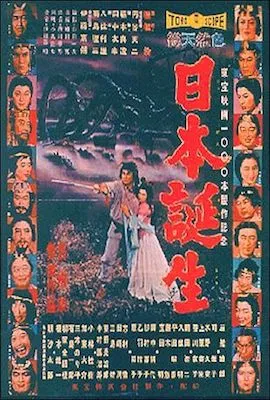
The Three Treasures, or Nippon Tanjô (Birth of Japan) in the original Japanese, was released on October 25th, 1959. It was produced by Toho, runs for 182 minutes, and was filmed in color widescreen. This was Toho's 1000th film, and the occasion demanded a suitably grand spectacle. Producer Tomoyuki Tanaka, who often handled "men's movies" in the action, war and sci-fi genres, collaborated with his contemporary Sanezumi Fujimoto, who worked primarily in dramas and comedies, in order to pull off this epic project. It was directed by Hiroshi Inagaki, who just a few years earlier had completed his Samurai trilogy of films (1954-1956) starring Toshiro Mifune, who also garnered the lead role in The Three Treasures. Akira Ifukube provided the traditional sounding score and Eiji Tsuburaya's special effects department contributed to key scenes. The Three Treasures is a sweeping tale that blends history and mythology, filled with romance, intrigue, duels and battles between gods and monsters and men, all driven by one of the most celebrated heroes of Japanese folklore.
The story follows Prince Ousu, a rugged and daring warrior with a short fuse. He catches his older brother with one of the emperor's concubines and beats him within an inch of his life. Otomo, the corrupt counselor to the emperor, uses this occasion to sway the emperor's heart against his son and send him on a suicide mission to subdue the Kumaso tribe. Ousu unexpectedly succeeds, earning the title "Yamato Takeru" as a result. Tensions flare as Otomo exerts all his influence to keep Ousu away from the throne. Ousu continues his journeys and learns to temper his wild spirit, but ultimately must contend with the treacherous forces arrayed against him.
The Three Treasures stars nearly every major player at Toho at the time, and just about every supporting actor as well. Toshiro Mifune headlines the cast in the dual roles of Prince Ousu during the main narrative, and the sea god Susano-o in the mythological interludes. Mifune once again plays the part of a wild man learning to control his demons, just like Musashi Miyamoto in the Samurai films, and it's an all-round great performance. Mifune is the core of the film, and the remaining players orbit around him. Yoko Tsukasa plays the shrine maiden Oto Tachibana, who figures in a forbidden romance that tests Ousu's resolve. Misa Uehara, best known as the princess from The Hidden Fortress (1958), plays a maiden Susano-o rescues from the serpent Orochi. Kyoko Kagawa plays Miyazu, another princess who competes with Tachibana for Ousu's love. Eijiro Tono plays the conniving counselor Otomo, with Kozo Nomura and Hisaya Ito as his accomplice sons. Setsuko Hara plays Amaterasu, sitting at the top of the Japanese pantheon. A number of familiar Toho supporting actors portray deities during the creation scene, and a veritable who's who of comedians fill the same roles during the heavenly cave sequence, including Norihei Miki, Kingoro Yanagiya, and Kenichi Enomoto. Koji Tsuruta, who previously played Mifune's rival in the Samurai films, gets a rematch here as a Kumaso chief. Akira Kubo, Akira Takarada, Akihiko Hirata, Jun Tazaki, Takashi Shimura, Kichijiro Ueda, Yoshio Kosugi, and Yu Fujiki are just a sampling of the names rounding out the cast.
There are three main effects sequences where Tsuburaya's work shines. First is the depiction of the creation that opens the film, an eerie sequence of the first gods calling forth the Japanese islands from the primordial mists. Second is the film's most famous scene, the duel between Susano-o and Orochi, the eight headed serpent. Orochi's first appearance isn't quite so convincing — it looks like what it is, a puppet — but the dragon fares much better in the close up shots once the duel begins. Finally is the "divine retribution" of the film's climax, when a villainous cohort of Otomo's soldiers are wiped out by an earthquake, a flood, and a volcanic eruption. The earthquake shots required a pull-apart set loaded with tons of soil, so that real actors could plunge into a real crevasse that opened up beneath them. The volcanic eruption used a large amount of real molten metal to simulate lava; the same effect was used previously during the climax of Rodan (1956).
When your film revolves around Japanese myth and folklore, Ifukube is really the only correct choice to provide your music. It's impossible to imagine the creation scene, the duel with Orochi, or any of the battle scenes without Ifukube's eerie, blaring, pounding score driving the narrative forward. The main theme is a vocal piece that plays under the main title, and referenced again during the climax, a sort of "ode to Yamato" that is quintessential Ifukube. Director Inagaki is no stranger to epics of this nature and tackles the challenge with aplomb. That said, The Three Treasures feels decidedly less vibrant than the Samurai films. Most of the historical narrative scenes have the same dull brown, green and gray palette, save for a few gloriously filmed sunsets. The combination of sets and locations is about on par with the Samurai films as well, although this does lead to some jarring cuts during the fight scenes. As stated before, the main theme of the film's story is the maturity of Mifune's character, although since this is also a commemorative film, it's just as much about celebrating both Japanese culture and Toho's milestone as it is about crafting a hero's journey narrative.
Scoring The Three Treasures is difficult for me. On my first viewing I did not have the benefit of historical context or decent subtitles, and the narrative portions of the film felt like a bit of a drag, while the effects scenes didn't quite live up to their hype. More recently, however, after coming to a fuller understanding of the actual story and how it connects to the folklore, my perspective has inverted and I now appreciate the narrative segments much more than the mythological set pieces. The film does still feel slow in places, and much of the action choreography is stilted, but the rush of energy that accompanies the finale makes it worth the 3 hour runtime. I rate it 3 out of 4 stars.