Review
Varan the Unbelievable
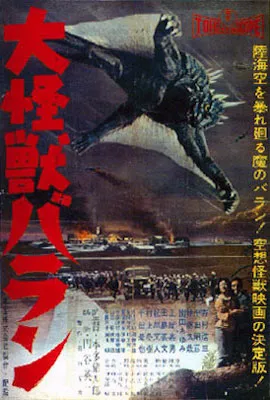
Varan the Unbelievable, or Daikaijû Baran (Giant Monster Varan) in the original Japanese, was released on October 14th, 1958. It was produced by Toho, runs for 87 minutes, and was filmed in black and white, initially in 1.33:1 or Academy aspect ratio, and then later converted to 2.35:1 aspect ratio via Toho Pan Scope. It was originally conceived as a television miniseries, co-produced with American studio AB-PT, hence the decision to shoot in Academy ratio and in black and white. AB-PT fell apart during production, and Toho salvaged the project for a Japanese theatrical release instead. Remaining footage was shot in widescreen and existing Academy footage was cropped to match, hence “Pan Scope.” Producer Tomoyuki Tanaka once again united the tokusatsu dream team of director Ishiro Honda, effects director Eiji Tsuburaya, composer Akira Ifukube, and screenwriter Shinichi Sekizawa to craft this film.
The film opens like an episode of a science fiction anthology, with footage of rockets launching and opening narration about the mysteries of the universe. The story focuses on Uozaki, a research assistant, Yuriko, a journalist, and Horiguchi, Yuriko’s photographer, who venture out to the wild countryside of Japan in search of Uozaki’s missing colleagues. They enter a secluded village where the residents worship a primal deity known as “Barandagi.” The deity reveals itself to be an enormous dinosaur-like creature, Varan, who emerges from its underwater lair to wreak havoc. Varan eludes the military, leading them on a chase through the coastal waters before landing in Tokyo, where the final showdown takes place.
Toho stacked this film with B-list actors, ostensibly a cost-cutting measure to ensure a successful sale to American broadcast networks. Kozo Nomura, a familiar face for genre fans, garners the lead role as Uozaki. His leading lady is played by Ayumi Sonoda, whose only other sci-fi credit is as a nightclub dancer in The H-Man (1958). Koreya Senda plays Uozaki’s mentor, Dr. Sugimoto. Senda was the highest profile actor in the film but the Sugimoto character is quite bland. He spends most of his time reading off exposition, which was possibly another deliberate choice to “keep things simple” for TV audiences. Akira Sera gives a decent performance as the chief priest of the secluded village. Fuyuki Murakami, Akio Kusama, and Yoshio Tsuchiya all appear as officials and soldiers, while Akihiko Hirata returns as yet another scientist, this time the inventor of the high powered explosive that’s used against Varan. Unfortunately there’s no real stand out performance in this ensemble; no one was falling over themselves to leave their mark on American television.
The best special effect of the picture is Varan himself, another suitmation creation brought to life by Tsuburaya’s crew and stuntmen Haruo Nakajima and Katsumi Tezuka. The creature’s design is one of the more intriguing in Toho’s bestiary, which is a shame because he never appeared in another film after this, apart from an insignificant cameo in Destroy All Monsters (1968). Although to be fair, his “flying squirrel” technique, complete with jet engine sound effect, is one of the more ridiculous moments of the film. The main tokusatsu set pieces involve three locations: the mountain lake and village, the open ocean, and a little strip of Haneda airport in Tokyo. The mountain village destruction scenes are the most well executed. The ocean scenes naturally use Toho’s “big pool,” with plenty of miniature boats and planes attempting to destroy Varan with elaborate depth charge traps. The finale at Haneda Airport is disappointing, to say the least, another consequence of cost-saving measures implemented by the studio. The Haneda set itself is sparse and featureless. Most of the Tokyo destruction scenes are actually stock footage inserts from the original Godzilla (1954), including an obvious shot of Godzilla’s tail smashing into a building. Even the evacuation scenes preceding Varan’s arrival are lifted from Godzilla.
Ifukube’s score is, thankfully, one of the few aspects of the film that does not disappoint. The main title theme, which also accompanies Varan’s attack on the village, is one of his best works. Ifukube would eventually rework parts of it into the Rodan theme introduced in Ghidorah, the Three-Headed Monster (1964), one of his most recognizable kaiju themes. Ifukube also resurrected a military march he’d written in 1944 to accompany the military in this film. The same march would be heard again in Battle in Outer Space (1959) and Frankenstein Conquers the World (1965).
Honda does the best he can with the material, but the material itself is the film’s biggest handicap. There are many story elements which don’t make a lot of sense. Uozaki chides the villagers for believing in Varan, yet when a village boy runs off into the mist, Uozaki vows to go and “save” him, even though he just got done explaining that there’s nothing to be saved from. Hirata’s scientist character developed a high-powered explosive, which explodes just fine, but he claims it’s “not ready,” as if merely exploding isn’t good enough or something. The plan to deliver the explosives to Varan relied on a blue-collar trucker agreeing on the spot to do a suicide run right at the monster. When that plan fails, Sugimoto warns that further actions will make the monster angry, an opinion uttered without a hint of irony as the monster very angrily destroys the airport. There’s virtually no character development, no romance or intrigue, and the film’s theme boils down to, “yes, there are mysteries out there, and sometimes those mysteries are monsters, but man will be victorious because of science.”
At the end of the day, Varan the Unbelievable is a hodge podge of mostly underwhelming set pieces, performances, and writing which amount to a film that’s at least not terrible, but certainly not very good, either. I rate it 2 stars out of 4.