Review
Warning from Space
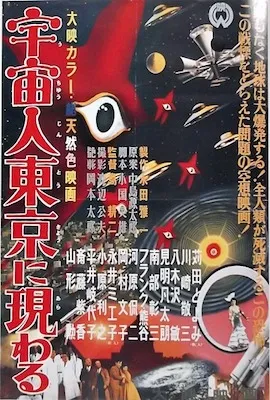
Warning from Space (Uchūjin Tōkyō Ni Arawaru, aka Space Men Appear in Tokyo) was released on January 29, 1956. It was produced by Daiei, runs 87 minutes, filmed in color at 1.37:1 aspect ratio. This was the first Japanese science fiction film in color, predating Toho’s Rodan by almost a full year, and the first Japanese science fiction film to feature aliens. Although promotional materials feature the film’s iconic starfish aliens towering over the cast, this is not a kaiju film — the aliens themselves are human sized and appear mainly in the first act. It was directed by Koji Shima and written by Hideo Oguni, a frequent collaborator on Akira Kurosawa’s films. The story borrows core concepts from American films The Day the Earth Stood Still and When Worlds Collide (both 1951), but spins them into something uniquely Japanese: more optimistic about the potential benefits of nuclear energy and touched by the promise of international cooperation. In Japan it is remembered less as a derivative work than as an influential one, notably for introducing the trope of aliens transforming into humans, a concept that became commonplace on 60s TV shows like Ultraman.
The story begins with the astronomy community on edge as unidentified objects streak across Japan’s skies. Several starfish-like aliens are spotted, but they never linger and their intentions are unknown. The encounters suddenly cease and things return to normal, until a strange woman is found who is an exact double of a famous entertainer. While she feigns amnesia, she is in fact a starfish alien transformed into a humanoid. She infiltrates the social circle of the country’s top scientists and reveals her twofold purpose: to convince the world to dispose of its nuclear arsenals by discharging them into the rogue planet R, on a collision course with Earth, and to prevent Dr. Matsuda from synthesizing the new element Urium. The Pairans discovered Urium centuries before and deemed it too dangerous even for research; the destructive potential of even a small amount would eclipse every nuclear arsenal on Earth. Tensions rise as other nations are skeptical of reports out of Japan, until Planet R is finally visible to Earth’s telescopes, only days from impact. On top of this, a careless comment to the press exposes Matsuda’s secret Urium research, and he is kidnapped by industrial spies eager to sell his work to the highest bidder.
Oguni’s script is tightly written, and the film does a good job of keeping things moving along, or at least maintaining interest during longer scenes of exposition. There are a few bits that detract from the overall experience. The manner in which the film’s tap-dance routines are introduced is jarring — neither routine feels like it enhances the story or atmosphere, serving only to introduce the headline dance talent the aliens copy for their infiltration scheme. The final act, with astronomers, their families, and refugees hiding in the observatory awaiting their fate, drags out a little too long, especially when most viewers will have already figured out how it’s going to end. One standout sequence is the Pairans’ strategy meeting aboard their vessel. In contrast to the rest of the film, the aliens and set design are starkly monochrome; the aliens fade in and out at the edges of the frame, speaking in subtitled alien language that is sophisticated and even humorous, culminating in the eerie transformation sequence when one adopts a human likeness for the mission.
The human characters, while not particularly flashy, are refreshingly three-dimensional. Unlike American sci-fi contemporaries, where characters are caught off guard by completely predictable events, the scientists here are no dummies — they quickly suspect their new visitor and confirm her extraterrestrial origins with a few simple experiments. In an interesting twist on what would become established formula, the leading trio comprises dusty old scientists, not a romantic couple as in Toho’s contemporary sci-fi films or a troupe of young children as in Daiei’s later Gamera films. Easily the most interesting character is Dr. Matsuda, played by Isao Yamagata (Seven Samurai [1954]), a prideful scientist on the cusp of synthesizing a revolutionary new element who must contend with both Pairan upbraiding and predatory industrial spies. Bontaro Miake and Shozo Nanbu round out the elder scientists as Drs. Komura and Isobe; their children, played by Keizo Kawasaki and Mieko Nagai, make for a picture-perfect couple if less memorable than their elders. Shiko Saito chews the scenery as the shamelessly evil industrial spy, and Toyomi Karita handles the dual role of infiltrating Pairan “Ginko” and the dance star whose appearance she copies, including a well-played confrontation with Matsuda over his research.
With most of the budget spent on the Pairan vessel sequence, the majority of the film is sparse on special effects for a so-called science fiction film. After the starfish aliens themselves, the most prominent visual effect is the encroaching Planet R, which spends most of its onscreen life as a red speck in a telescope lens. The nuclear launch scene plays out in silence through that same lens, as streaks of light dart into Planet R with seemingly zero effect. The remaining effects are economical yet convincing: a crafty low-angle miniature of a building and radio tower experiencing a brownout as a UFO streaks overhead, and the mysterious trails of icy blue flame left after the alien encounters in the first act — an effect that certainly justifies the decision to shoot in color. The one clear disappointment is the shot of a UFO rising from the bay and ascending to the Pairan mothership, which comes off looking like a very small, very cheap toy on a wire.
The score by Seitaro Omori is sparse but effective, with no standout motifs but plenty of atmosphere. The ominous themes accompanying the aliens during their first appearances, as well as the transformation sequence, are phenomenal. A particularly effective moment occurs when the younger Isobe and Tomoko are out on their boat; the music has been the epitome of springtime up till now, but takes a sour, ominous turn when Isobe spots the floating Ginko.
In the final analysis, Warning from Space is one of the better Japanese science fiction films of the 1950s — thoughtful, well written, and filled with great characters, likable and unlikable. The starfish aliens have become iconic fixtures in the genre, even if they’re not featured as prominently as one would like. The visual effects and music do a lot with less. That said, there’s no clear standout lead to drive the narrative, and I take issue with the pacing of the latter half and some of the editing. Overall it’s a fun watch, and I rate it 3 out of 4 stars.